Opinion : Family Rule and National Looting: How Museveni’s Nepotism Mirrors Africa’s Despotic Legacy

our rulers become insecure in their sumptuous offices and therefore they must surround themselves with their own relatives with whom, of course, they loot the national treasury.’
In the annals of African political history, Yoweri Museveni’s leadership in Uganda appears to follow a troubling and all-too-familiar script. Journalist David Lamb’s account of President William Tolbert of Liberia and his systematic family appointments eerily parallels what is taking place in Uganda today. Just as Tolbert surrounded himself with family members in the corridors of power, so too has Museveni crafted a similar network in Uganda—an intricate web of nepotism that raises serious concerns about governance, transparency, and democracy.
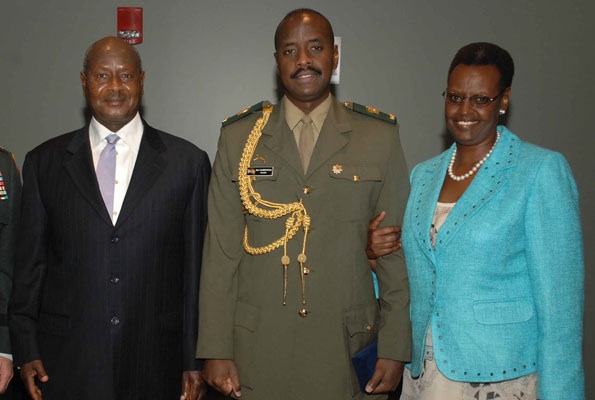
The appointment of Museveni’s wife Janet as Minister of Karamoja, his son Muhoozi as the commander of Special Forces, his brother Salim Saleh as a Senior Presidential Advisor, and numerous other relatives in key state positions has created an atmosphere where political power is increasingly concentrated within the Museveni family. This mirrors the very same patrimonialism that defined the regimes of Mobutu Sese Seko in Zaire and Daniel arap Moi in Kenya—regimes where family and clan were prioritized over national interest, and where loyalty to the ruler, rather than merit, determined appointments.
While Museveni’s apologists argue that figures like Saleh and Kutesa merit their positions, the reality is that Uganda is home to countless talented individuals who are equally, if not more, capable of fulfilling these roles. The continued appointment of family members to influential positions sends a disheartening message to the Ugandan populace: that meritocracy is secondary to loyalty, and the higher echelons of power are reserved for the select few who share the president’s bloodline.
This informalization of power, as observed by Dr. Oloka Onyango and journalist Charles Onyango-Obbo, is not new in African politics. The reliance on family rule reflects Museveni’s growing insecurity and the need to surround himself with individuals he can trust implicitly. In this context, blood ties offer the ultimate form of loyalty—far more reliable, in Museveni’s view, than the allegiance of political associates or technocrats. Yet, as seen in the case of Mobutu, such nepotism eventually contributes to the erosion of state institutions, as power becomes an insular, family affair.
The larger question that arises from Museveni’s political maneuvers is this: Has Uganda truly moved forward since the days of Tolbert, Mobutu, and Moi, or has the country merely witnessed a “change in the wind” rather than the promised “wind of change”? Museveni’s entrenchment of family rule, coupled with his dismantling of national institutions, suggests that Uganda is more entrenched in the very political practices it once sought to escape. It is deeply ironic that a leader who once denounced such African dictatorships now presides over one of his own making.
Museveni’s nepotism reflects a fundamental distrust in state institutions. Like Mobutu, Museveni seems to understand that holding onto power requires not just brute force but a well-maintained network of trusted kin. As Uganda moves further into this neo-patrimonial system, the president’s original promise of “fundamental change” rings increasingly hollow. What remains is a state where power is less about serving the nation and more about perpetuating a dynastic rule.
In the end, the cost of this nepotism will not only be borne by Museveni’s successors—who will inherit a country deeply fractured by regional, ethnic, and political divisions—but also by the Ugandan people, whose dreams of a meritocratic and democratic society will be continually deferred. As Bidandi Ssali astutely observed, Museveni’s political grooming did not include learning from elders or building institutional integrity. Instead, he has entrenched a system of family rule that serves to secure his own political future at the expense of the nation.
Uganda now finds itself at a critical juncture, where the informal power wielded by the president’s kin threatens to overshadow the formal institutions of governance. As Museveni’s tenure continues, Uganda risks falling into the same trap that ensnared so many African nations before it—a trap where loyalty to the president supersedes loyalty to the country, and where the state’s resources are looted by a small clique of family members. This is the anatomy of family rule in Uganda today, a reality that raises grave concerns about the future of governance in the country.