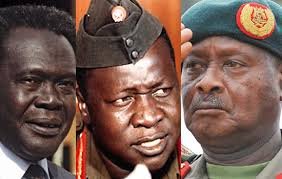

Uganda’s modern political landscape continues to evoke comparisons with its turbulent past. A historical examination of state practices between the 1970s–1986 and those in the present day suggests that despite regime change, many instruments of repression have endured, albeit under different forms and names.
Repressive Mechanisms: A Comparative View
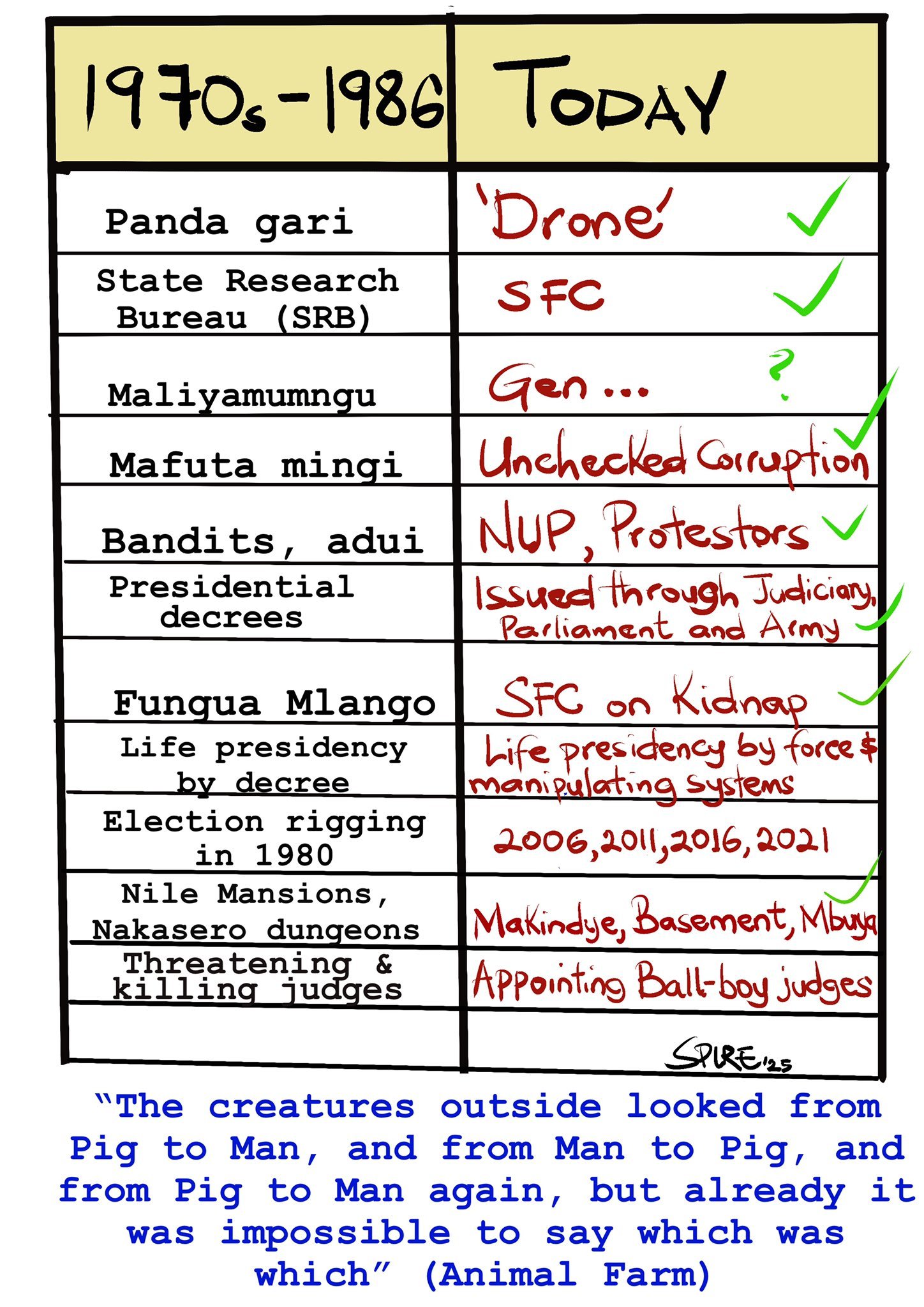
In the 1970s, Ugandans lived under the shadow of arbitrary abductions, detention without trial, and political violence. The infamous “panda gari” operations—where citizens were rounded up in military trucks—instilled widespread fear. Today, that imagery is mirrored in the use of “drones”, unmarked vans employed in the abduction of government critics and opposition activists.
The State Research Bureau (SRB) of Idi Amin’s era, notorious for its extrajudicial methods, finds its parallel in the Special Forces Command (SFC), a contemporary security organ frequently cited in allegations of abductions and human rights abuses.
Corruption, described historically as “mafuta mingi” (too much oil), has evolved into what many analysts regard as unchecked corruption, eroding public trust in state institutions.
The political language of enemies—“bandits” and “adui”—once used to delegitimize dissenters, has today been replaced by references to protestors and members of the National Unity Platform (NUP), who are often portrayed as threats to national stability.
Institutional Continuities
Uganda’s past was marked by governance through presidential decrees, often circumventing democratic processes. In the present, state directives are enforced through the judiciary, parliament, and military structures, reflecting a shift in form rather than function.
The idea of a life presidency, once explicitly proclaimed by decree, is today secured through systemic manipulation and contested electoral processes (2006, 2011, 2016, 2021). This reflects a historical continuity in the entrenchment of power, with elections serving more as instruments of control than genuine competition.
The notorious detention centers of the past—Nile Mansions and Nakasero dungeons—have modern equivalents in Makindye, Basement, and Mbuya, which have similarly been associated with illegal detention and alleged torture.
Even the judiciary, once threatened with violence during the 1970s, today faces a crisis of independence, with allegations of compromised appointments and politicization.
The Animal Farm Analogy
The closing quotation from George Orwell’s Animal Farm—“it was impossible to say which was which”—offers a literary lens through which to interpret Uganda’s historical cycle. Revolutionary movements that rose to challenge past dictatorships have, in the eyes of critics, adopted the very practices they once denounced.
This continuity suggests a systemic problem: while leaders and regimes change, the structures of repression adapt and persist. The result is a historical pattern in which hope for liberation is repeatedly undercut by the re-emergence of authoritarian practices.
The parallels between Uganda’s past and present reveal a nation still grappling with the legacies of authoritarianism. The methods have evolved—from panda gari to drones, from decrees to judicial directives—but the underlying issues of repression, corruption, and political control remain.
For historians and political observers, Uganda’s case demonstrates the difficulty of breaking cycles of authoritarian governance. Unless structural reforms are undertaken to safeguard the independence of institutions, protect civil liberties, and ensure accountability, the shadows of the past will continue to haunt the present.