Electoral Commission’s Friday Night Letter to Kyagulanyi Fuels Fears of Bias Ahead of 2026 Polls

Electoral Commission’s Delayed Letter Raises Fresh Concerns of Bias
By The Hoima Post Opinion Desk
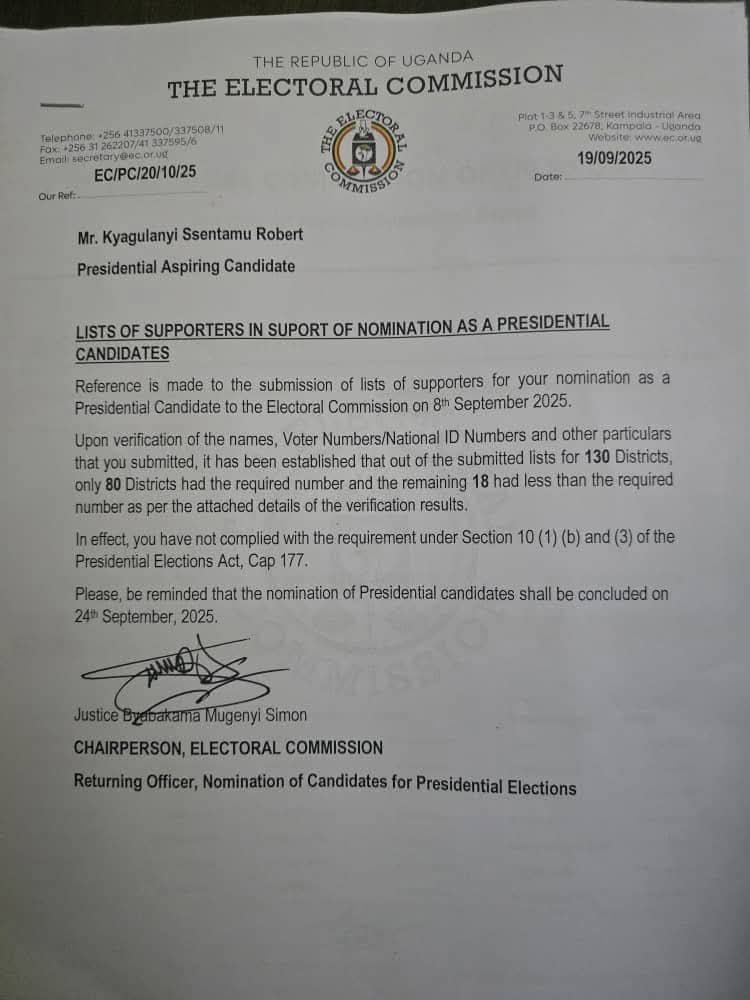
On Friday evening, September 19, 2025, past 6:00 pm, the Electoral Commission (EC) delivered a letter to presidential aspirant Robert Kyagulanyi Ssentamu, raising questions about timing, transparency, and impartiality in the run-up to the 2026 elections.
The letter, signed by EC Chairperson Justice Simon Byabakama, claims that Kyagulanyi failed to meet the threshold of verified signatures from 98 districts as required by law. According to the Commission, only 80 districts had the minimum verified number, while 18 districts fell short. Yet, the letter provides no detailed breakdown of which signatures were accepted and which were rejected.
> “This delayed communication coming after close of business on a Friday—shows a troubling pattern. If the aspirant had not raised the alarm earlier in the day, the EC might have waited until Monday, leaving virtually no time to address the alleged deficiencies before Tuesday’s scheduled nomination,” said a political analyst based in Kampala.
Kyagulanyi’s camp insists they submitted more than enough signatures and accuses the Commission of acting in bad faith.
> “We know what we submitted. We know it is more than sufficient. What the Commission is doing is not verification; it is obstruction. These are clear signs of a regime afraid of the protest vote in 2026,” said one member of his campaign team.
The incident underscores broader concerns over the independence of Uganda’s Electoral Commission. Though legally mandated to operate as a neutral referee under the Presidential Elections Act (Cap. 177), critics argue the body has long functioned under the shadow of executive influence.
> “The President appoints both the Chairperson and Commissioners of the EC, subject only to parliamentary approval. In a country where the ruling party dominates Parliament, that process rarely reflects independence. The result is a Commission that often appears more accountable to State House than to the Ugandan voter,” observed a governance expert from Makerere University.
As Kyagulanyi’s campaign prepares to submit additional signatures in the coming days, the episode has already deepened public suspicion. Civil society voices warn that the credibility of the 2026 polls is at stake if the EC does not demonstrate transparency and fairness.
The Commission has until September 24, 2025, to conclude the nomination process. Ugandans are watching closely not just the numbers, but the integrity of the process itself.