
[ad_1]
Despite legal advances, LGBT+ people face severe discrimination in Sierra Leone
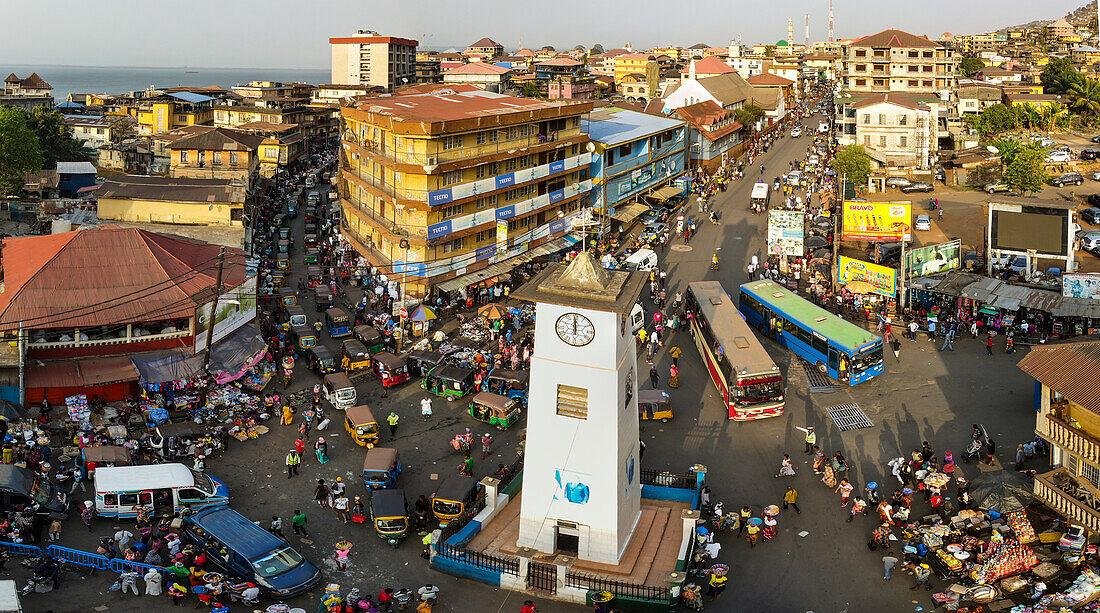
Freetown, the capital of Sierra Leone (Photo by George R. Freeman Browne)
Sierra Leone, a small English-speaking country in West Africa, is rarely discussed amid a deepening crisis for LGBT+ rights among its neighbors, but the legal and economic realities for its queer citizens remain fraught.
George Reginald Freeman Browne, the executive director of Pride Equality International—an NGO working to combat HIV in Sierra Leone and among the diaspora in Spain—shares his insights with 76Crimes on the economic situation of LGBT+ people in his home country.
Legal Framework in Sierra Leone
Erasing 76 Crimes: What is the political and legal framework surrounding LGBT+ rights in Sierra Leone?
George Reginald Freeman Browne: Sierra Leone, which has been independent since 1961, inherited British colonial laws, including a law dating back to 1861 that criminalizes sexual relations between individuals of the same sex. In principle, homosexuality is punishable by life imprisonment under the law, although the law is rarely enforced.
Erasing 76 Crimes: Do you have any idea how many people are incarcerated for homosexuality in Sierra Leone?
Browne: I have no idea, because it’s difficult to cross-reference information regarding arrests in the country. There is no such statistical tool.
However, the colonial law is still used as a lever to extort money from LGBT+ people.
Also, since 2023, some progress has been made in the fight against workplace discrimination, with the adoption of a law prohibiting homophobia (Editor’s note: The Employment Act 2023 bans discrimination based on “sexuality”). However, in practice, this law is largely unknown or ignored.
Employment of LGBT+ People
Erasing 76 Crimes: What is the situation regarding LGBT+ economic rights in Sierra Leone?
Browne: There is an urgent need to address the social and economic inclusion of LGBT+ people who cannot hide their identity and who live on the margins of the Christian and Islamic communities that are widespread in Sierra Leone.
For transgender people, I would even be inclined to think that the situation is even worse, as they face discrimination not only on the basis of their sexual orientation but also their gender identity and expression. Access to the job market is effectively barred to them, despite the law.
Only gay and lesbian people who manage to conceal their sexual orientation manage to get by, and a few lead a decent and comfortable life.
Erasing 76 Crimes: What economic activities are LGBT+ people involved in in Sierra Leone?
Browne: LGBT+ people open hair salons, as well as small restaurants and taverns where local customers can eat. Others sell sandwiches and skewers on the street. As for transgender people, sex work is often their means of earning a living and making ends meet on a daily basis.
Erasing 76 Crimes: What initiatives exist to promote LGBT+ people’s access to credit?
Browne: Initiatives led by international organizations such as the Voluntary Civil Organization do provide loans, but the target audiences are primarily women or young girls. LGBT+ communities do not interest these organizations, and the same issue applies to openly lesbian women.
Furthermore, even though microfinance is designed to provide access to financing for the most vulnerable groups, in practice, the interest rates charged are sometimes usurious, with the total amount repaid amounting to 4 or 5 times the initial loan amount; moreover, the amounts granted vary greatly depending on the resources of the guarantors required, when there is no mortgage secured against the home or family jewelry.
All of this creates barriers or mechanisms of dependency that are further reinforced by the requirement to have the moral support of a traditional rural community leader or the backing of an influential businesswoman who represents the members of her association. Without their respective approval, in most cases, there is no financing.
LGBT+ people are largely confined to informal employment (Photo by George R. Freeman Browne)
Erasing 76 Crimes: What proposals do you have in light of this situation?
See Also
Browne: In Sierra Leone, LGBT+ advocacy and activist groups operate in small, loosely organized groups and lack the knowledge or capacity to address issues such as microfinance.
Moreover, there are no studies on LGBT+ people’s access to microcredit.
In this context, just as with training programs for women, LGBT+ people also need tools and knowledge about microcredit and would be eager to learn more.
There is a clear lack of a platform that can bring together LGBT+ individuals who wish to embark on entrepreneurship in a structured manner and who need support not only in accessing financing but also in managing business accounting.
The Tourism Lever
Erasing 76 Crimes: Can tourism be a driver of employment and tolerance through interaction with international visitors?
Browne: Jobs related to tourism represent a source of development (Editor’s note: transportation, lodging, restaurants, tours, nightlife, and the entertainment and cultural industries).
And indeed, international visitors are likely to be more exposed to certain forms of diversity and less inclined to discriminate.
Nevertheless, this economic sector is poorly managed by the authorities, as Sierra Leone is not a very popular international destination. And even though the country has colonial forts, beautiful beaches, and chimpanzee sanctuaries, most of the infrastructure is neglected or poorly promoted culturally.
For example, to enter Sierra Leone, you must pay a $50 tourist tax. Similarly, to take the ferry across the strait separating the airport from the capital, you must pay another $50 each way—all obstacles that prevent Sierra Leone from being a competitive tourist destination.