
By Alexander Luyima
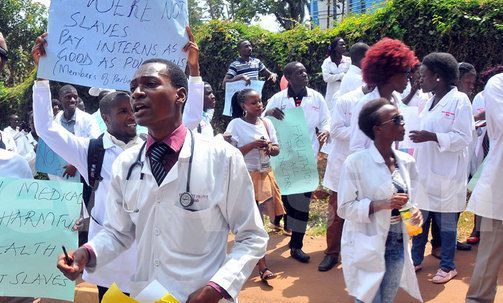
As Uganda continues to grapple with a shortage of healthcare workers, a growing controversy surrounding medical interns has ignited a national conversation about leadership, public spending, and the future of the country’s healthcare system.
At the heart of the debate is a simple but powerful question: If medical interns are essential to the functioning of Uganda’s hospitals, why is the government considering withdrawing their financial support while continuing to allocate substantial resources to political expenditures?
The issue has exposed competing perspectives from government officials, healthcare professionals, and the interns themselves. Yet beyond the differing viewpoints lies a broader concern about the priorities of a nation striving to improve healthcare outcomes while facing significant economic constraints.
Government’s Argument: Expanding Opportunity for More Graduates
Defending the government’s position, Dr. Chris Baryomunsi argues that the landscape of medical education in Uganda has changed dramatically over the years.
“In the past, government has been paying an allowance for the interns,” Dr. Baryomunsi explained. “But this started when there were very few doctors coming out of universities.”
According to the minister, the expansion of both public and private universities has significantly increased the number of graduates seeking internship placements, stretching available government resources.
“You find that the majority remain at home because government can’t afford to support everyone,” he said. “A decision was taken that if we remove the allowance, we can enable all doctors, pharmacists, nurses and other graduates from public and private universities to undertake internship.”
The government’s position is rooted in the belief that increasing access to internship opportunities for all graduates may ultimately benefit the healthcare sector, even if financial allowances are reduced or removed.
“It is intended to give an opportunity to all students who qualify and attain their degrees to proceed and do internship and not be constrained by lack of resources,” Dr. Baryomunsi added.
Healthcare Professionals Push Back
Many healthcare professionals, however, believe the government’s reasoning overlooks the realities within Uganda’s hospitals.
Dr. Frank Asiimwe has emerged as one of the most vocal critics of the proposal.
“Interns are actually employees. They must be paid to do the work because they do the work,” Dr. Asiimwe said. “They do 70 percent of the work that is done in hospitals where interns are.”
His argument challenges the perception that interns are simply students completing an academic requirement. In many public hospitals, interns routinely participate in patient care, emergency response, ward management, documentation and clinical procedures under supervision.
“If you don’t pay them and don’t take charge of their livelihood, you cannot control them,” he warned. “You cannot expect them to be on the ward by seven or eight in the morning when they may be struggling to afford transport or basic necessities.”
Dr. Asiimwe further argues that intern welfare is directly linked to patient safety.
“You are not protecting the patients,” he said. “What happens to the student whose parents cannot support them? Where will they get lunch? Where will they get dinner?”
Perhaps most concerning is his warning that forcing healthcare workers into financial hardship may unintentionally create conditions that encourage corruption and unethical conduct.
“There’s going to be extortion,” he cautioned. “Such conditions can create opportunities for unethical practices that are created by the same system.”
The View from the Frontline
For many medical interns, the issue extends beyond allowances and enters the realm of national priorities.
One intern recently captured the frustration felt by many young healthcare professionals.
“The irony of our government is that on one hand it claims it doesn’t have money to support medical interns as they prepare to become part of the healthcare workforce.”
Uganda continues to face a shortage of doctors relative to its growing population.
“If you look at our doctor-patient ratio, it is already terrible,” the intern noted.
Yet what has generated the strongest public reaction is the comparison between healthcare funding and political spending.
“This country says it doesn’t have money for interns, but it has money to afford luxury vehicles worth hundreds of millions of shillings for Members of Parliament.”
The intern further noted that medical internship is not optional.
“You cannot practice as a medical doctor in Uganda unless you have fully completed your internship period. The fact that they are pulling the rug from under the feet of people that we so badly need in our country is really absurd.”
More Than an Internship Debate
While government officials emphasize fiscal realities and expanding access to training opportunities, healthcare professionals emphasize service delivery, patient safety and workforce sustainability.
The two sides are asking different questions.
Government asks: How can Uganda accommodate the growing number of graduates entering the healthcare system?
Healthcare workers ask: How can Uganda expect interns to provide essential medical services without ensuring their basic welfare?
Citizens ask an even broader question: What does the country’s spending reveal about its priorities?
No nation has unlimited resources. Every government must make difficult decisions about how public funds are allocated. However, budgets are ultimately statements of national priorities.
When young doctors, nurses, pharmacists and other healthcare professionals are told there is insufficient funding to support their mandatory training while substantial expenditures continue elsewhere, it is inevitable that questions will be raised.
The future of Uganda’s healthcare system depends not only on producing more graduates but also on creating conditions that allow them to serve effectively, ethically and sustainably.
The medical interns controversy is therefore about much more than allowances. It is a debate about investment, leadership, accountability and the kind of future Uganda wants to build.
For a country seeking to strengthen its healthcare system and improve outcomes for millions of citizens, the answer may ultimately lie not in whether resources are available, but in how those resources are prioritized.
—
About the Author
Alexander Luyima is a Registered Medical Worker in Ontario, Canada, and serves as Director of Community Programs and Information at African Descent Ontario (ADSON). He writes on healthcare, community development, public policy, governance and issues affecting African and diaspora communities.