Eight Officials Charged in Major Corruption Case as Debate Grows Over Detention of Opposition Figures

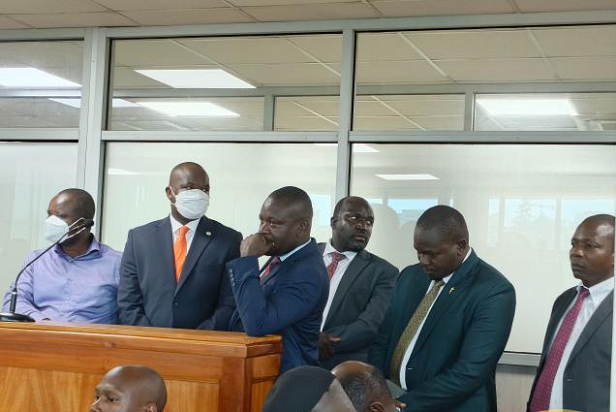
The charging of eight current and former parliamentary officials over alleged corruption-related offences involving billions of Uganda shillings has reignited debate over accountability, equal justice, and the rule of law in Uganda.
According to the charge sheet, the accused face allegations including embezzlement, causing financial loss, and money laundering involving substantial sums of public money. The allegations stem from an investigation into the alleged misuse of funds within Parliament.
The officials charged include:
| Name | Position | Alleged Amount (UGX) | Primary Charge |
|---|---|---|---|
| Daniel Adilo | Director, Human Resources | 14.609 billion | Embezzlement |
| Chris Ariko Obore | Director, Communications & Public Affairs | 5.253 billion | Embezzlement |
| Vincent Otebata | Capacity Development Officer | 5.253 billion | Embezzlement |
| Leonard Okema | Executive Secretary, Speaker’s Office | 3.489 billion | Embezzlement |
| Rajab Kaaya Ssemalulu | Principal Research Officer | 2.170 billion | Embezzlement |
| Emmanuel Emuron Okwi | Principal Protocol Officer | 1.105 billion | Embezzlement |
| Stella Itute | Office Supervisor, Sergeant at Arms | 75 million | Embezzlement |
In addition to the individual charges, prosecutors allege that the accused—except Murebe—collectively caused a financial loss of UGX 27.201 billion. Murebe and six others also face money laundering charges involving UGX 10.893 billion, according to the charge sheet.
The prosecution argues that the accused participated in activities that resulted in the unlawful diversion and concealment of public funds. The court process will determine whether the evidence presented is sufficient to establish guilt beyond a reasonable doubt.
Public Debate Over Equal Application of Justice
The case has sparked renewed public discussion beyond the allegations themselves.
Many Ugandans have questioned whether the justice system applies the law consistently to all citizens, particularly when comparing high-profile corruption prosecutions with the detention of opposition politicians and activists.
Critics argue that while officials accused of financial crimes often proceed through the criminal justice process, some opposition figures have spent extended periods in detention while awaiting trial or resolution of their cases. Supporters of the government, on the other hand, maintain that each case should be judged on its own facts and legal merits, and that courts—not public opinion—should determine outcomes.
Legal analysts note that corruption cases and political prosecutions are governed by different legal frameworks, but emphasize that constitutional principles such as due process, the presumption of innocence, and timely access to justice should apply equally to everyone.
The allegations have also renewed calls for stronger financial oversight within public institutions.
Governance advocates argue that safeguarding public resources is essential for maintaining confidence in government institutions. They contend that transparent investigations, independent prosecutions, and fair judicial proceedings are critical to ensuring accountability and deterring corruption.
At the same time, civil society organizations have continued to call for reforms that strengthen judicial independence, improve the efficiency of criminal proceedings, and ensure that all accused persons—regardless of political affiliation or public office—receive equal treatment before the law.
The charges announced against the officials remain allegations. Under Ugandan law, all accused persons are presumed innocent unless and until they are found guilty by a competent court.
As proceedings continue, prosecutors will be required to present evidence supporting the charges, while the defence will have the opportunity to challenge that evidence and present its own case.
The outcome of the trial is expected to be closely watched, not only because of the billions of shillings allegedly involved, but also because it has intensified broader national conversations about corruption, governance, accountability, and equal justice under the law.