
[ad_1]
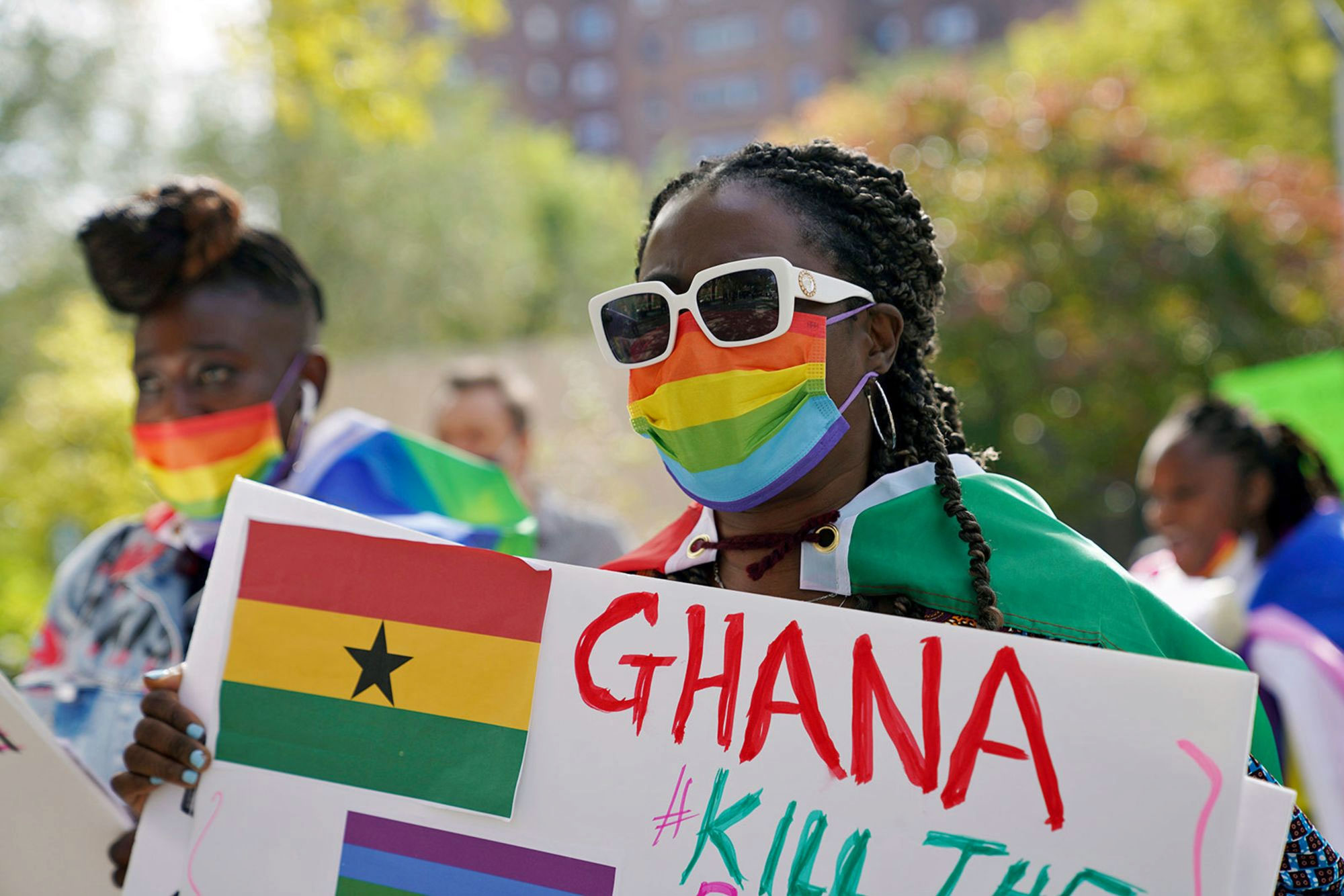
Protester seeks recognition of LGBTQ rights in Ghana. (Photo courtesy of Labari Journal)
The largely anti-LGBTQ parliament of Ghana will play host next week to anti-LGBTQ officials from throughout Africa with the goal of eliminating LGBTQ rights throughout the continent.
The conference, scheduled for June 3-6 in Accra, will target LGBTQ rights, women’s rights, sexual and reproductive health and rights, civic freedoms, and democratic participation across Africa, human rights defenders warn.
“The Accra conference is a heavyweight gathering: parliamentary figures, legal institutions, advocacy organisations, and African Union engagement, collectively working on anti-human rights strategies,” says Jeffrey Haynes, emeritus professor of politics at London Metropolitan University. “It is a strategic consolidation point for a broader, Western far-right-directed initiative with the objective of reshaping Africa’s governance, family policy, gender rights, and human rights frameworks.”
The gathering’s formal name is the Fourth African Inter-Parliamentary “Family, Sovereignty and Values” Conference, which will be held at the large interdenominational Accra Ridge Church, with Ghana President John Dramani Mahama expected to serve as Special Guest of Honour.
LGBTQ rights at risk, LGBTQ activists divided
The conference comes at a time when Ghana’s parliament is again discussing the anti-LGBTQ bill that would make it a crime to identify as gay or support LGBTQ rights, would impose a three-year sentence for same-sex intimacy and up to 10 years for promoting LGBTQ rights in print, broadcast or online. That bill passed unanimously in 2024 but expired at year’s end when it had not been signed by then President Nana Akufo-Addo.
The persistence of support for the draconian anti-LGBTQ bill has led to divisions within the nation’s LGBTQ community.
Abdul-wadud Mohammed
In early May, Abdul-Wadud Mohammed, the former communications director for LGBT+ Rights Ghana, published an essay criticizing Ghana’s queer advocacy movement for “intellectual bankruptcy and strategic timidity”. He argued that in March activists missed the chance to highlight the immorality of Ghana’s support for repression of its LGBTQ citizens at a time when Ghana served as the “moral conscience of a global movement for reparatory justice” in its advocacy of a United Nations resolution declaring the transatlantic slave trade the “gravest crime against humanity.”
Next month, Ghana’s activists will have a renewed opportunity to focus on the hypocrisy of embracing the modern-day immorality of LGBTQ repression while seeking justice for the past immorality of the slave trade, he says. That opportunity will be front and center when Ghana hosts the High-Level Next Steps Conference on Reparatory Justice on June 17-19 in Accra.
“A government that wants to lead on reparative justice for slavery while legislating modern oppression is vulnerable,” he wrote. “Why isn’t the queer movement exploiting the contradiction?”
A shortage of funds for LGBTQ advocacy complicates the problems confronting Ghana’s LGBTQ activists, says activist trans musician Angel Maxine Opoku.
“Due to inadequate funding, there is a lot of fatigue”, she says. “Activists are finding it difficult to mobilize and strategize. … The call-out in [Abdul-Wadud Mohammed’s] article is for the activists at the top to put efforts in finding viable strategies to deal with the anti-LGBTQ+ bill rather than continuing with the past advocacy efforts that are not yielding any tangible results at the moment.”
A push to define ‘African cultural identity’ as heterosexual
In its own words, next week’s African Inter-Parliamentary Conference will focus on “African cultural identity,” family systems, food sovereignty, digital governance, artificial intelligence, and youth development.
For human rights supporters, that means the conference will seek to institutionalize heterosexual family structures while opposing LGBTQ+ rights, abortion access, comprehensive sexuality education, and broader gender justice frameworks.
A key component of the conference agenda is a proposed Draft African Charter on Family, Sovereignty and Values, which the LGBTQ advocacy group Rightify Ghana says would threaten existing human rights protections under African and international charters and treaties.
In the run-up to the conference, the human rights advocacy group JustRight Ghana took aim at the hotel corporation where the gathering was to be held — Four Points by Sheraton, a Marriott International franchisee.
JustRight Ghana put pressure on Marriott, threatening a boycott and urging Marriott “to act swiftly & responsibly … A company with a global commitment to diversity, inclusion, and human rights cannot remain silent while its facilities are used to host a conference associated with anti-women agendas and anti-LGBTQ+ issue.”
Marriott buckled under the pressure. Its hotel is still listed as a site where conference-goers can reserve rooms, but the conference itself will be at the Accra Ridge Church.
Sharon Slater, President of Family Watch International. (Photo courtesy of The Guardian)
Taking direction from Western homophobes
Professor Haynes of London Metropolitan University, writing in the online Labari Journal, said:
The involvement of prominent Ghanaian parliamentarians may obscure that the direction, financing, and ideological focus of the conference are not African.
Behind the African faces and the ‘protection-of-family-values-and-sovereignty’ language are two wealthy and influential Western far-right organisations: USA-based Family Watch International, and Christian Council International from the Netherlands.
Both organisations have close ties to President Donald Trump and his administration, and seem determined to impose their alien ideas and values on Africans.
See Also
Sharon Slater, President of Family Watch International – designated as a ‘hate group’ by the Southern Poverty Law Centre – and Henk Jan van Schothorst, founder and CEO of Christian Council International (CCI), have been spreading their anti-rights narratives into Africa since the 2010s.
They target Africa with their anti-rights values and ideologies under the guise of protecting ‘African traditional family values’ and Africa’s ‘sovereignty’.
Van Schothorst’s organisation, CCI, claims that it drafted the anti-rights ‘African Charter on Family Sovereignty and Values’.
The draft charter prescribes discrimination and the rolling back of rights across Africa. It is no coincidence that the first three conferences were held in Uganda, where in 2023 President Yoweri Museveni signed into law a draconian ‘anti-gay law’, with homosexual activities punishable by death.
Ghana’s position as a bastion of democracy in a region undergoing democratic backsliding is lending legitimacy to the anti-rights agenda.
The background to the Accra conference is that many Africans are concerned about what they regard as the baleful influence of Western-style modernisation, believing it to be a key driver of cultural erosion and moral decline.
Rapid adoption of Western norms by many young people is thought to have created a ‘moral vacuum’, with traditional values – such as communal responsibility, respect for elders, and modesty – replace by rampant individualism, materialism, and corruption.
The dual focus of the 4th Interparliamentary Conference on Family Values and Sovereignty – ‘family values’ and ‘sovereignty’ – no doubt appeals to many Africans concerned that, in the race for progress and development, traditional values are being lost.
It is, however, a concern that Africans’ legitimate concerns are being weaponised by Western far-right groups and their local allies, while Africa’s long history of tolerance and harmonious inter-cultural living is ignored, as are Africa’s historically diverse and fluid social structures.
Instead, the conference focuses on a narrow, ‘imported’, definition of ‘family’ and ‘values’ that overlooks the continent’s history of tolerance and community-focused ‘living well together’ and respect for diversity.
Critics, such as Kemi Akinfaderin of Fòs Feminista, a global feminist alliance for reproductive justice with 180 partners across 35 countries, argue that such conferences impose Western anti-liberal agendas under the guise of defending tradition.