
By Alexander Luyima | The Hoima Post
There are laws that people hear about in Parliament and forget the moment the debate ends.
Then there are laws whose consequences can eventually find their way into the kitchen, the market, the fuel station and the school fees envelope.
Uganda’s Protection of Sovereignty Law belongs in a conversation about the latter.
Because behind all the legal language about sovereignty, foreign influence, foreign funding and national security is another Uganda that does not speak the language of Parliament.
It is the Uganda of the mother in Masaka whose daughter works in Toronto.
It is the father in Wakiso whose son works in London.
It is the young businessman in Kampala whose brother sends money from New York.
It is the grandmother whose daughter in Dubai sends money every month for medicine and food.
For these Ugandans, money coming from abroad is not a political ideology.
It is survival.
The Ugandan who never appears in the parliamentary debate
Imagine an ordinary Ugandan whose brother works in Canada and sends US$500 every month.
That money pays rent.
It buys food.
It pays school fees.
It may pay a hospital bill.
It may provide capital for a small business.
Now imagine another Ugandan whose daughter works in the United States and sends US$2,000 home every month.
That family may never meet a government official.
They may never attend a political rally.
They may have absolutely no interest in influencing Uganda’s politics.
They simply have a relative abroad who is trying to help them survive.
This is why the debate surrounding Uganda’s Protection of Sovereignty legislation deserved more than political slogans.
It deserved an economic conversation.
And during the parliamentary scrutiny of the proposed law, that conversation came directly from the institution responsible for Uganda’s monetary stability.
The Bank of Uganda sounded the alarm
On April 28, 2026, Bank of Uganda Governor Michael Atingi-Ego appeared before Parliament’s joint committees considering the Protection of Sovereignty Bill.
The central bank warned that the Bill, in its proposed form at the time, could weaken the shilling, drain Uganda’s foreign reserves and affect the cross-border financial flows that sustain the economy.
The Governor specifically identified foreign investment, remittances and portfolio capital as important sources of foreign currency that help Uganda finance its trade deficit.
His warning was blunt: restrictions that significantly reduced those inflows could put pressure on the country’s foreign reserves and the value of the shilling.
That warning should matter to every Ugandan.
Because when an economist talks about foreign reserves and exchange-rate pressure, the ordinary Ugandan eventually hears the consequences in a much simpler language:
“Why has everything become so expensive?”
And now the dollar has crossed 4,000 shillings
Uganda’s shilling has since come under significant pressure.
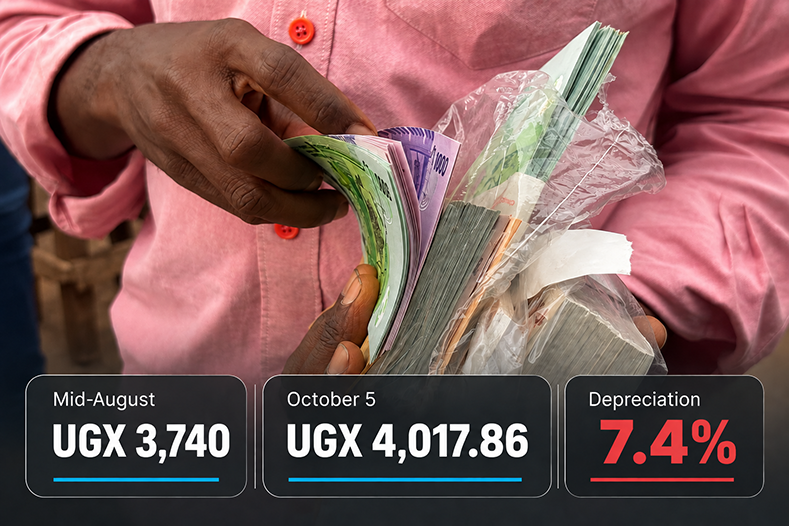
In early October 2026, the shilling crossed the psychologically important UGX 4,000-per-US-dollar level, reaching new record lows. Commercial banks were quoting rates above 4,000, while reports attributed the immediate pressure to strong demand for dollars, particularly from importers, alongside broader international market pressures.
That distinction is important.
It would be wrong to say that the Sovereignty Law alone caused the shilling to reach 4,000 to the dollar.
There are several forces behind the currency’s depreciation, including increased dollar demand from importers, global energy and geopolitical pressures and movements in international financial markets.
But that does not make the Bank of Uganda’s earlier warning irrelevant.
Quite the opposite.
It tells us why policymakers should be extremely careful about any measure that could unnecessarily discourage legitimate foreign-currency inflows into Uganda.
What does UGX 4,000 mean to an ordinary Ugandan?
Forget the economics textbook for a moment.
Think about a family.
If someone in Canada sends US$500 home, at an exchange rate of approximately UGX 4,000 to the dollar, that is about UGX 2 million before transfer charges and exchange-rate differences.
US$1,000 becomes approximately UGX 4 million.
US$2,000 becomes approximately UGX 8 million.
For a family receiving money from abroad, a weaker shilling can mean more Uganda shillings when converting the dollars.
But the same depreciation creates pressure elsewhere because Uganda also needs dollars to pay for many imported goods and services.
And that is where the ordinary Ugandan feels the other side of the story.
The exchange rate does not remain on a computer screen at a bank.
It can eventually affect the price of fuel, imported medicines, machinery, electronics, business inputs and other goods whose costs are linked directly or indirectly to foreign currency.
The pain eventually reaches the household.
This is what Hon. Odonga’s argument brings into focus
The point raised by Hon. Odonga in the discussion is worth translating into everyday Ugandan language.
Suppose your uncle in New York sends you $2,000 every month.
You are not an opposition politician.
You are not a foreign agent.
You are not trying to undermine the Government.
You are simply buying matoke.
You are paying school fees.
You are helping your mother.
You are supporting your children.
You are keeping a small shop open.
You are building a house.
You are paying a medical bill.
That money becomes part of Uganda’s economy the moment it enters the country.
It is spent by families.
It circulates through shops.
It pays workers.
It supports businesses.
It contributes to demand for goods and services.
And Uganda’s central bank has recognised remittances as an important source of foreign exchange.
So the question should never be whether Uganda has the right to protect itself from illicit foreign influence.
Of course it does.
The harder question is:
How do you protect national sovereignty without unnecessarily making it harder for legitimate money to enter the country?
The danger is not only about politics
This is where the sovereignty debate becomes an economic debate.
If legitimate investors become afraid to bring money into Uganda, that matters.
If diaspora Ugandans become uncertain about sending money home, that matters.
If businesses face unnecessary barriers to receiving legitimate foreign payments, that matters.
If foreign-currency inflows weaken while Uganda continues to require dollars to finance imports, that matters.
And if the supply of foreign currency becomes more constrained while demand for dollars remains strong, the shilling can come under additional pressure.
That is precisely why the Bank of Uganda’s intervention during the parliamentary debate deserved attention. The central bank was not discussing political slogans. It was discussing the mechanics of Uganda’s economy.
Sovereignty must also protect the people
There is nothing wrong with Uganda wanting to protect itself against terrorism financing, money laundering, illicit foreign interference or foreign funding intended to manipulate the country’s political affairs.
A sovereign country has a legitimate interest in knowing where politically sensitive foreign money comes from and how it is being used.
But there is an enormous difference between stopping illicit foreign influence and creating unnecessary fear around legitimate money sent home by Ugandans living abroad.
The Ugandan diaspora is not simply a source of foreign currency.
It is part of the country’s social and economic fabric.
A nurse in London sending money to her parents in Jinja is part of Uganda.
A truck driver in Canada supporting his children in Kampala is part of Uganda.
A Ugandan engineer in the United States investing in a family business is part of Uganda.
A daughter in Dubai paying her mother’s medical bills is part of Uganda.
Their money is not an abstract financial statistic.
It is somebody’s school fees.
Somebody’s rent.
Somebody’s medicine.
Somebody’s lunch.
Somebody’s business capital.
The warning should not be forgotten
The Bank of Uganda’s warning should therefore remain part of the public conversation.
Not because every movement of the shilling can be blamed on one law.
It cannot.
The current depreciation has multiple causes, and the recent move beyond UGX 4,000 per dollar has been linked to strong dollar demand, particularly from importers, as well as wider global pressures.
But the central bank warned Parliament months earlier that weakening important foreign-currency inflows could create precisely the kind of economic pressure policymakers should be trying to avoid.
That warning deserves to be remembered whenever Uganda considers legislation affecting international financial flows.
Because the consequences of economic policy do not remain inside Parliament.
They eventually arrive at the market.
They arrive at the petrol station.
They arrive at the pharmacy.
They arrive at the school.
And eventually, they arrive at your pocket.
The question Uganda should be asking
The sovereignty debate should therefore not be reduced to Government versus opposition.
It should not be reduced to supporters versus critics.
It should be about getting the balance right.
How does Uganda protect its national sovereignty while keeping its economy open to legitimate investment, trade and diaspora support?
How does the country stop illicit foreign political influence without making an ordinary Ugandan afraid that money from a brother in Toronto or a daughter in London could suddenly become a problem?
How does Uganda protect the state while also protecting the people whose daily work, businesses and families keep the economy moving?
Those are not opposition questions.
They are Ugandan questions.
Because at the end of the day, sovereignty is supposed to mean more than protecting the authority of the state.
It should also mean protecting the economic security and dignity of the people.
And when the US dollar is crossing UGX 4,000, while families continue struggling with the rising cost of living, the warning from the Bank of Uganda deserves to be taken seriously.
The parliamentary debate may have started with sovereignty.
But for the ordinary Ugandan, the real question is much closer to home:
What will this mean for my family, my business and the money in my pocket?
By Alexander Luyima | The Hoima Post