
[ad_1]
Proposed bill would have reiterated Uganda’s homophobic laws
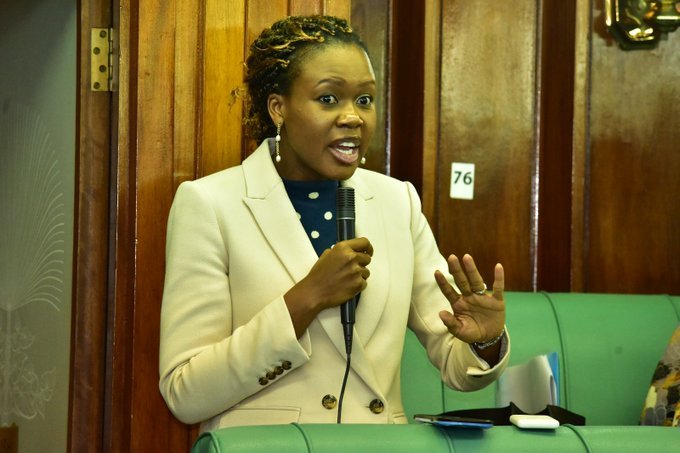
Ugandan member of parliament Anna Adeke introduced the proposed Sexual Offences Bill, which has now been withdrawn from consideration. (Photo courtesy of Ugandan Parliament)
The Parliament of Uganda has decided to do away with the proposed Sexual Offences Bill after 10 years of failed attempts to have it enacted.
The bill had sought to codify sex-related crimes, including crimes related to homosexuality, but was not supported by the government because everything it proposed was already illegal under the Penal Code and other laws.
On March 12, 2026, the Sexual Offences Bill was withdrawn by Flavia Nabagabe, the Kassanda Woman Member of Parliament, on behalf of its mover, Anna Adeke, the Soroti Woman Member of Parliament, saying that the conflicting views received during the consideration of the bill threatened to alter its intended objectives.
The move followed an announcement made by Speaker Anita Among, who informed Parliament that government had reservations about the bill because many of its proposals were already criminalised under existing laws.
“It has emerged that government has reservations given that the object of the bill is defining and criminalising sexual offences, which is already covered under the existing laws. To conserve time and effort, I will ask the sponsor of the bill, who was Anna Adeke and who has delegated Flavia of Kasanda to bring a motion of withdrawal,” Among said.
Human rights defenders welcomed the decision to withdraw the bill saying it is a step in the right direction.
“While recent versions removed the explicit 10-year penalty for same-sex acts found in earlier drafts, the focus remained dangerously close to policing private relationships rather than addressing violence,” Human Rights advocate Frank Mugisha wrote on X.
He says that Uganda needs laws that genuinely protect all people from violence, not tools for persecution.
“Progress must mean protecting the rights of all,” he says.
The Sexual Offences Bill was first introduced in Parliament in 2015 by the then Kumi District Woman Representative Monicah Amoding, a year after the Anti-Homosexuality Act, 2014 was declared null and void by the Constitutional Court on procedural grounds.
After four years of review by the Committee on Legal and Parliamentary Affairs, the bill was returned to the floor of Parliament in February 2019 for the first reading.
Clause 11 (a) (Unnatural Offences) of the Sexual Offences Bill 2019 specifically targeted the LGBTQI+ community.
After its first reading, Chapter Four Uganda in its written memorandum on the Sexual Offences Bill called for the removal of Clause 11(a), noting that the clause was vague, broad, and another attempt to legislate in a manner that promotes discrimination against Ugandans who identify as Lesbian, Gay, Bisexual, Transgender, Intersex or Queer (LGBTIQ).
“This provision as it exists in the Penal Code has been construed as criminalising consensual adult behaviour between LGBTIQ persons, and re-enacting this provision will further entrench homophobia and transphobia in the society. This would be contrary to recognised human rights standards and amount to cruel, inhuman and degrading treatment of LGBT+ Ugandans,” Chapter Four Uganda stated.
The bill was nonetheless passed on 5 May 2021, but President Yoweri Museveni declined to assent to it, saying that the offences it contained in were already covered by the Penal Code Act and that the new provisions in the bill were redundant.
See Also
Adeke re-introduced in October 2024. In her justification for the bill, Adeke said that, “Whereas sexual offences are mainly prescribed under the Penal Code Act, various laws such as the Prevention of Trafficking in Persons Act, the Domestic Violence Act, and the Children Act, make provision for a number of sexual offences.”
She argued that there is need to ensure the legislation responds to the evolving and current trends in sexual offences, curbs sexual violence and adopts international best practices in the prevention of sexual violence.
The 2024 version had left out Clause 11 (a) on Unnatural Offences but proposed a death sentence for aggravated rape, criminalised indecent gestures such as touching one’s sexual organs with a three-year sentence, and proposed a similar punishment for a person who exposes his sexual organs to anyone while in public.
In response to the withdrawal of the Sexual Offences Bill, Kuchu Times Media group issued the following statement.
Contrariwise, this bill was not primarily about sexual violence, as indicated by its movers; it targeted LGBTQ individuals in Uganda, and just like the Anti-Homosexuality Act, 2023, it would be used as a weapon of mass destruction against minority Ugandans in the LGBTQ community.
While the Anti-Homosexuality Act, 2023, bites us, the LGBTQ persons, with several of our colleagues already in prison, while we navigate the already unbearable living conditions in Uganda, the Sexual Offences Bill, 2024, would only worsen the already-worse situation.
Thus, the striking down of the Sexual Offences Bill, 2024, by Honourable Adeke, is somewhat a relief to LGBTQ individuals in Uganda, who are already wrestling with the Anti-Homosexuality Act, 2023, which has led to increased homophobia in the country, and while it might come across as a paltry win, we embrace it with a smirk, as we believe that even a single step forward is essential towards our progress.