
By Alexander Luyima | The Hoima Post
As Uganda creeps closer toward its next political crossroads, the public square remains dangerously fixated on a binary spectacle. Political analysts, media houses, and everyday citizens are heavily invested in a singular, high stakes question: Will the future belong to the fiery opposition stance of Bobi Wine (Robert Kyagulanyi), or will it transition to the military pedigree of Gen. Muhoozi Kainerugaba?
It is a captivating drama, filled with generational friction, contrasting ideologies, and deep seated anxieties about the post Museveni era. Yet, according to one of the primary architects of Uganda’s constitutional framework, this obsession is a dangerous distraction.
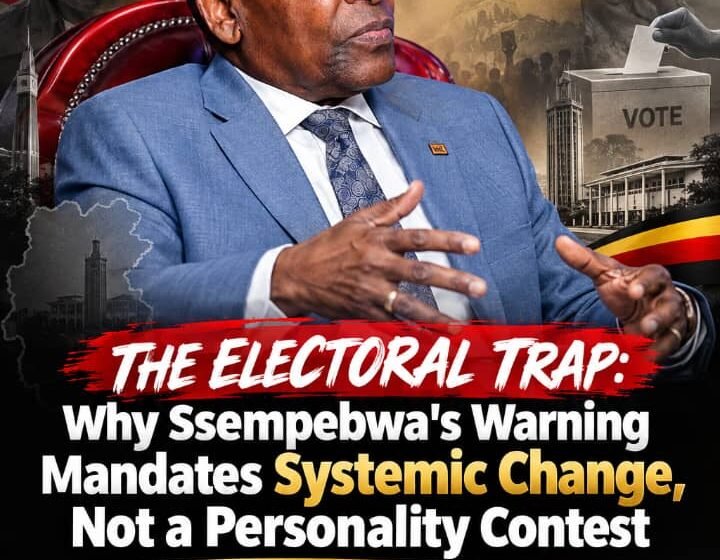
Speaking recently on BBS Terefayina, Professor Fredrick Ssempebwa, the eminent jurist who chaired the landmark Constitutional Review Commission, issued a sobering reality check that should reverberate through every corner of our political discourse. His thesis was clear, concise, and entirely unsparing: The fundamental issue facing Uganda is not choosing between Bobi Wine and Gen. Muhoozi, but rather changing the system itself.
Professor Ssempebwa’s warning strikes at the very heart of Uganda’s democratic deficit. For decades, our national politics has been reduced to an arena of personalization, where salvation or ruin is projected onto individual figures. We treat elections like a change of personnel rather than an interrogation of power. But as Ssempebwa rightly implies, substituting the driver does very little good if the vehicle’s engine is fundamentally broken.
The current system is not failing by accident; it is failing by design. It is a system characterized by an overcentralized executive, eroded institutional checks and balances, and a political economy that treats state machinery as a tool for patronage. If these structural realities remain untouched, any leader, no matter how well intentioned or powerful, will eventually find themselves constrained by, or co opted into, the same machinery of governance.

Furthermore, Ssempebwa pointedly directed his critique toward current maneuvers to alter the Constitution, particularly the quiet, calculated whispers aimed at shifting Uganda toward a parliamentary system where MPs, rather than universal adult suffrage, would select the president. Ssempebwa called these efforts what they are: a mistake. He reminded the nation that during the constitutional consultations, the citizens of Uganda explicitly rejected a parliamentary system for choosing the head of state. To reverse this now is not an act of legislative reform; it is a direct subversion of the popular will designed to insulate power from the ballot box.
To make matters worse, this systemic decay is enabled by widespread socioeconomic vulnerability. When poverty is weaponized and institutionalized, the electorate is stripped of its agency. A voter preoccupied with basic survival is inherently vulnerable to political manipulation and financial influence. True democratic choice cannot exist in a vacuum of economic desperation.
Therefore, the challenge ahead of us cannot be solved by simply rallying behind a preferred political savior. The conversation must shift from who sits in the State House to how that institution relates to citizens, the law, and the economy.
Ugandans must demand a comprehensive overhaul: the restoration of genuine constitutionalism, the independence of state institutions, and an economic model that prioritizes the dignity of the ordinary citizen over political survival.
Professor Ssempebwa has held up a mirror to the nation. If we continue to treat our future as a mere personality contest between Bobi Wine and Gen. Muhoozi, we will remain trapped in an endless cycle of disillusionment. It is time to stop arguing over who holds the steering wheel and finally start rebuilding the system.